Planning building work near a neighbour?
Check which Party Wall notices you may need before you start.
Answer a few plain-English questions about your project. We'll explain which notices may apply, what information you need, and what to do next. This guide is for homeowners working under the Party Wall etc. Act 1996, which applies in England and Wales, and is written by the party wall surveyors at Alderton Associates.
What this tool does not check
Party Wall notices are only one part of getting ready for building work. This tool does not check:
- planning permission;
- permitted development;
- building regulations;
- structural design;
- freeholder consent;
- leaseholder consent;
- restrictive covenants;
- rights of light;
- boundary ownership;
- scaffold or access licences;
- neighbour agreements outside the Party Wall etc. Act 1996.
This tool provides general guidance, not legal advice.
It helps homeowners understand when Party Wall notices may be needed. It does not confirm that a notice is valid or complete. Party Wall matters can depend on the exact works, property ownership, drawings, dates and method of service. If you are unsure, speak to a suitably experienced party wall surveyor or legal adviser before relying on the output.
What might the Party Wall process cost? If your neighbour consents, the process may be relatively simple. If they dissent, or do not respond where the Act treats this as a dispute, surveyors may need to be appointed and a Party Wall Award may be prepared.
In many typical cases, the building owner pays the reasonable costs of the Party Wall process, including reasonable adjoining-owner surveyor fees. Costs can vary depending on the number of adjoining owners, complexity of the works, whether one agreed surveyor is used, and whether there are disputes about damage, access, design or method of working.
There can be exceptions to the usual cost allocation — for example unreasonable or unnecessary costs, costs of separate legal advice, or matters falling outside the Party Wall Act.
This tool does not give fixed prices. Speak to a suitably experienced party wall surveyor for an estimate that fits your project.
How long does the Party Wall process take? Timescales depend on the notice type and how the adjoining owner responds.
As a simple guide:
- Line of Junction Notice (Section 1): usually at least 1 month before work starts.
- Party Structure Notice (Section 2/3): usually at least 2 months before work starts.
- Adjacent Excavation Notice (Section 6): usually at least 1 month before work starts.
If the adjoining owner consents, the process may be quicker and simpler. If they dissent, or do not respond where the Act treats this as a dispute, surveyors may need to be appointed and a Party Wall Award may be needed before notifiable works start.
Do not leave notices until the week before works are due to begin.
How to serve a Party Wall notice A notice should be served on each adjoining owner. Keep a record of what was served, when, how, and to whom.
Common service methods may include:
- delivering it by hand;
- sending it by post;
- sending by email only where email service is appropriate and accepted.
Do not assume a casual email, text message or WhatsApp message is enough.
After serving:
- record the date served;
- keep copies of the notice and any drawings;
- diarise the response deadline where relevant;
- keep any written acknowledgement or response;
- do not start notifiable works until the notice period has expired or the matter has been properly agreed or resolved.
Common questions.
Plain-English answers to the questions homeowners most often ask about the Party Wall etc. Act 1996. Use these as general guidance — take advice if you need certainty in a specific case.
A Party Wall notice is a formal written document telling your neighbour about proposed works covered by the Party Wall etc. Act 1996. It usually applies when you are doing certain works to a shared wall or structure, building a new wall on or near the boundary, or excavating close to a neighbouring building. The notice gives the neighbour a chance to respond before works start.
Party Wall etc. Act 1996Not always — it depends on the works. Notices are usually needed where the work affects an existing shared wall or structure, where you are building a new wall on or near the boundary, or where excavation goes close to a neighbouring building. Many extensions involve at least one of these. Use the notice checker to work out which notices may apply to your project.
For many Party Wall notices, if the adjoining owner does not respond within 14 days, a dispute is treated as having arisen and surveyors may need to be appointed. If the adjoining owner then fails to appoint a surveyor within 10 days of a written request, the building owner may appoint one for them.
Section 1 boundary-wall notices work differently, especially where a new wall is proposed astride the boundary. Silence should not be treated as consent to build on the neighbour's land. Take advice if you are unsure.
Sections 5, 6(7), 10Dissent is a formal response that means the Party Wall Act dispute-resolution process continues, usually leading to a Party Wall Award. It does not necessarily mean the neighbour objects to the works themselves — many adjoining owners dissent simply to make sure they have the protection of an Award.
Not usually. Dissent means the neighbour is asking for the Party Wall Act process to continue formally — typically through surveyors and a Party Wall Award. Most works can still go ahead under an Award, with conditions on hours, access and damage make-good.
In many typical cases, the building owner pays the reasonable costs of the Party Wall process, including reasonable adjoining-owner surveyor fees. Costs can vary depending on the number of adjoining owners, complexity of the works, whether one agreed surveyor is used, and whether disputes arise about damage, access, design or method of working.
There can be exceptions, for example if costs are unreasonable, unnecessary, relate to separate legal advice, or fall outside the Party Wall Act. Check before relying on this.
Sections 10(13), 11Email service should not be assumed valid unless it is clearly appropriate and accepted in the circumstances. Many practitioners still serve by post or hand delivery and keep a record. Do not assume a casual email, text message or WhatsApp message is enough. Take advice if you are unsure.
If notifiable work starts without notice, the adjoining owner may seek an injunction or other legal remedy. You cannot simply fix the Party Wall process retrospectively after the works are complete. If you think notice may apply, deal with it before the work starts. Take advice if you are unsure.
No. The Party Wall Act is a separate matter from planning permission, permitted development and building regulations. You may need any combination of these — they don't replace each other. Check each one separately for your project.
You can address the notice to "The Owner" of the adjoining property where the owner's name is not known. You should still make reasonable checks first — for example by asking on site or checking the Land Registry. Where you can identify the legal owner, name them.
Adjacent Excavation Notices (Section 6) usually need plans and sections showing the proposed excavation, the foundation depth, and the distance to the neighbouring building or structure. This tool does not check whether your drawings are technically adequate — your designer, structural engineer, builder or party wall surveyor may need to help.
The app helps you prepare draft notices. You should review the names, addresses, dates, drawings and method of service before serving. Where the work is unusual, where there are multiple owners, leaseholds, or where excavation drawings are needed, take advice before relying on the draft.
The Party Wall etc. Act 1996 does not require a party wall surveyor to have a specific qualification, but you should choose someone experienced in party wall matters. Many are chartered surveyors or specialist party wall practitioners. RICS membership and party wall experience are useful filters, but not legal requirements.
Each adjoining owner usually needs their own notice. Where a single property is owned freehold and let on a long lease, both the freeholder and the leaseholder may need to be served. Flats above and below can also bring in multiple owners — each treated as a distinct adjoining owner under the Act. Take advice if you are unsure who the legal owners are.
England and Wales only. Scotland and Northern Ireland have separate legal frameworks and the Party Wall etc. Act 1996 does not apply there.
The Act puts the obligation to serve notices on the building owner — the adjoining owner cannot serve a notice on their own behalf. If you believe works that may be notifiable have started or are about to start without a notice having been served on you, you can usually take a graduated approach: an informal conversation first, a polite written request next, and a final-warning letter before considering legal advice.
For a step-by-step walk-through with editable letter templates, see the dedicated .
Party Wall etc. Act 1996 — Sections 3, 6Plain-English glossary.
Common Party Wall terms explained in homeowner language. These definitions are general guidance only — take advice if you need certainty in a specific case.
- Adjoining owner
- The neighbour or property owner affected by the proposed works.
- Building owner
- The person or people planning to carry out the works.
- Party wall
- A wall shared by two properties, often the wall between terraced or semi-detached houses.
- Party fence wall
- A shared boundary wall that is not part of a building, such as a garden wall on the boundary. Timber fences are not usually party fence walls.
- Party structure
- A shared structure, such as a floor or wall separating flats.
- Line of junction
- The boundary line between two pieces of land.
- Notice
- A formal document telling the adjoining owner about proposed works covered by the Party Wall etc. Act 1996.
- Dissent
- A formal response that means the Party Wall Act dispute-resolution process continues. It does not necessarily mean the neighbour objects to the works.
- Party Wall Award
- A formal document prepared by surveyor(s) setting out how the notifiable works should be carried out.
- Agreed surveyor
- One impartial surveyor appointed by both owners.
- Third surveyor
- A surveyor selected by the two appointed surveyors to resolve disputes if needed.
- Special foundations
- Foundations involving reinforced concrete or other special construction. These can require specific consent in some circumstances.
- Schedule of Condition
- A record of the neighbouring property's condition before works start.
- Adjoining occupier
- A person occupying the neighbouring property, who may not necessarily be the legal owner.
From notice to works.
A high-level guide to the typical Party Wall sequence. The notice period and response rules can vary depending on the type of notice, so use this as an outline rather than a rule that applies identically to every case.
Sequence at a glance
- 01 Serve notice
- 02 Response period
- 03 Consent / appoint surveyors
- 04 Prepare Schedule of Condition
- 05 Issue Award
- 06 Commence works
before
Plan the works and identify adjoining owners
An is, broadly, a neighbour or property owner with a relevant legal interest in a neighbouring property affected by the works. There can be more than one — including flats above, below or beside, and freeholders alongside long leaseholders. Where a name is not known, "The Owner" can be used as a fallback.
before
Prepare the notice and any drawings
Some notices need supporting drawings — for example excavation notices usually need plans and sections showing the proposed excavation and foundation depths. Many homeowners also line up a party wall surveyor before serving notice so they are ready if the matter goes to dispute.
Serve notice on each adjoining owner
The notice period depends on which sections apply. Line of Junction () and Adjacent Excavation () notices usually need at least 1 month before work starts. Party Structure () notices usually need at least 2 months. Where multiple notices apply, the longest period usually governs the earliest start.
Sections 1, 3, 6Consent, dissent, or no response
For many Party Wall notices, the adjoining owner has 14 days from service to respond. If no written response is received within that period, a is treated as having arisen and surveyors may need to be appointed.
Do not assume silence means consent. Response rules depend on the notice type — Section 1 boundary-wall notices, especially where a wall is proposed astride the boundary, work differently.
Sections 5, 6(7)If the neighbour consents
If the adjoining owner gives , the process may be quicker. Works can usually proceed at the end of the notice period. A is still strongly recommended — without it, later damage claims can be harder to resolve.
→ jump to Phase 05If they dissent or do not respond (where this creates a dispute)
For many notice types, surveyors may need to be appointed and a may be prepared before start. Owners can either jointly appoint one , or each appoint their own surveyor.
→ continue to Phase 04Ask the adjoining owner to appoint a surveyor
The request is normally in writing. The adjoining owner can either agree to use a single "agreed surveyor", or appoint their own surveyor. Each surveyor acts impartially under the Act, not as an advocate for the owner who appointed them.
Section 10(1)after request
If the adjoining owner does not appoint, the building owner may appoint for them
If the adjoining owner does not appoint a surveyor within 10 days of the building owner's written request, the building owner may appoint a surveyor on their behalf. This is one of the main safeguards against an unresponsive process.
Section 10(4)(b)Select a third surveyor
Where two surveyors are appointed, they usually select a at the start. The third surveyor only acts if the appointed surveyors cannot agree on a matter — they are a tie-breaker, not a third opinion that is automatically used.
Section 10(1)(b)Inspect — Schedule of Condition
A photographic and written record of the adjoining owner's property before works start. This is the surveyors' principal evidence base if a damage claim is later made under section 11.
Draft and serve the Party Wall Award
A Party Wall Award is a formal document prepared by surveyor(s) that sets out how the notifiable works should be carried out — including working hours, access, and how damage will be dealt with. It is signed by the surveyor(s) and served on both owners.
Section 10(10)after award
Either owner can appeal the Award to the County Court within 14 days of service. After 14 days the Award is generally binding and conclusive. Appeals are uncommon and can be costly.
Section 10(17)Works begin in line with the notice or Award
Works can usually begin once the notice period has expired (where the neighbour has consented), or once any Party Wall Award is in force and the appeal period has passed. Works must comply with any conditions in the Award.
Follow the Award and reasonable working hours
An Award typically sets working hours (commonly weekday daytimes, restricted Saturday hours, and no working Sundays or bank holidays). Changes to the agreed scope usually need a varied Award, not a unilateral change.
Final inspection and damage
Once works are complete, the surveyor(s) typically re-inspect the adjoining property and compare against the Schedule of Condition. Any damage caused by the notifiable works should be made good or compensated under section 11.
Section 11Common notifiable works.
Click any marker for an example of where a Party Wall notice may apply on a typical house, with a plain-English explanation and the relevant section of the Party Wall etc. Act 1996. This is illustrative — not an exhaustive list.

Eight common examples.
Click any numbered marker on the drawing for a plain-English explanation, the relevant section of the Party Wall etc. Act 1996, and the typical notice period. This shows examples — your project may be different, so check before relying on this.
- Sections referenced
- 1, 2, 6
- Notice forms
- N1, N2, N6
- Typical periods
- 1 or 2 months
Examples shown on this house
-
1 · Section 2
Chimney stack on the party wall
Works to a chimney stack that sits on a shared wall — for example, taking it down or rebuilding it — usually need a Party Structure Notice.
-
2 · Section 2
Loft conversion cutting into the party wall
Cutting in beams, padstones or pockets to support a loft conversion is normally notifiable party-structure work.
-
3 · Section 2
Chimney breast removal
Removing a chimney breast from a shared wall affects the structure of the party wall and usually needs a Party Structure Notice.
-
4 · Section 2
Steel beam into the party wall
Inserting a steel beam that bears into the shared wall — common in extensions and openings — is notifiable.
-
5 · Section 1
New wall on or near the boundary
Building a new boundary wall — wholly on your land or astride the line — is covered by Section 1 Line of Junction notices.
-
6 · Section 2
Rear extension flank against the party wall
Where a new extension flank ties into a shared wall, party-structure notices typically apply.
-
7 · Section 6
Foundations or excavation within 3 metres
Excavation within 3 metres of a neighbouring building, deeper than its foundations, normally needs an Adjacent Excavation Notice with drawings.
-
8 · Section 6
Deep excavation within 6 metres
Deeper excavations within 6 metres can also trigger Section 6 under the 45-degree rule. Drawings or sections are usually needed.
Received a Party Wall notice?
Do not ignore it. A Party Wall notice usually asks you to respond within a set period, often 14 days depending on the notice type. Your response affects what happens next.
Your first steps
- Check the date you received the notice.
- Identify what type of notice it is.
- Read what works are proposed.
- Check whether drawings or details are included where needed.
- Decide whether to consent, and use an , or dissent and appoint your own surveyor.
- Ask for clarification if the notice or drawings are unclear.
- Keep a copy of everything you receive and send.
You do not need to understand every legal term before taking the first step. Start by checking the notice type, deadline and proposed works.
What type of notice have you received?
Party Wall notices usually relate to one of three broad situations. Read the description on the notice — the type of work being proposed will usually tell you which one applies.
Hover or tap any dotted term below for a plain-English explanation.
Important: If the notice says the wall will be built astride the boundary, do not assume silence means consent. Written consent may be needed before a wall is built partly on your land.
Commonly linked to of the Party Wall etc. Act 1996.Drawings: Excavation notices usually need drawings or sections showing the proposed excavation and foundations.
Commonly linked to of the Party Wall etc. Act 1996.A single project can trigger more than one notice — for example a rear extension might bring works to a shared wall and excavation for foundations at the same time. Treat each notice on its own merits, but the response options below are the same.
Your response options.
Your options depend on the notice type and what is being proposed, but most adjoining owners will be choosing between consent and dissent. Tap any card to see what each one means in practice.
Does dissent mean I am objecting?
No. In Party Wall language, dissent does not usually mean you are objecting to the works in the planning sense.
It usually means you want the Party Wall Act procedure to continue, often so that a Party Wall Award can be prepared. The Award sets out how the notifiable works should be carried out and can include safeguards for the adjoining owner.
You can dissent because you want the process properly documented, even if you do not object to the idea of the works.
The document that sets the rules ()
A is a formal document prepared by the appointed surveyor or surveyors. It usually sets out what work is covered, how and when may be carried out, and any safeguards that apply.
Typical contents
- The works being authorised under the Act
- Working hours
- Method of working
- Access arrangements where relevant
- Protection measures
- Drawings and details
- Schedule of condition
- What happens if damage occurs
- Surveyor costs
Caution
- An Award deals with Party Wall matters. It does not replace planning permission.
- It does not replace building regulations approval.
- It does not replace freeholder consent.
- It does not replace leaseholder consent or other separate permissions.
- The Award is concerned with the matters in dispute under the Act, not every neighbour issue.
What the works are — and aren’t
The Award usually defines the scope of the notifiable works in detail, by reference to drawings and method statements. Works outside that scope generally fall outside the Award — meaning the building owner usually cannot unilaterally change the design later without re-engaging the surveyors and producing an addendum.
Working hours, access, security
Standard working hours are commonly 08:00–18:00 weekdays, 08:00–13:00 Saturdays, none on Sundays or bank holidays. The Award may also cover any access required onto your land (under section 8), the giving of reasonable notice before access, and any security for expenses required from the building owner.
S. 8, S. 12
What happens if your property is damaged
The Award typically sets out the procedure: any damage caused by the notifiable works should be made good by the building owner’s contractor or, at the adjoining owner’s election, paid for in compensation. The surveyors usually re-inspect after works against the Schedule of Condition and certify the position.
S. 7, S. 11
14 days to appeal — then usually binding
An owner who is dissatisfied with the Award generally has 14 days from service of the Award to appeal to the County Court. After that, the Award usually becomes binding. Appeals are uncommon.
S. 10(17)
Recording your property before works begin ()
A is a record of the visible condition of the adjoining property before the start. It is usually prepared with photographs and notes.
What it can do for you
- It can help distinguish existing cracks or defects from any damage alleged to have occurred during the works.
- It is often the comparison document used to deal with damage claims.
- The same document is useful whether you consent or dissent — request one either way.
What it may include
- External photographs of the parts of your property closest to the works
- Internal photographs of rooms adjoining the party wall, and rooms above or below the proposed works
- Written notes of existing cracks, dampness marks, settlement, plaster blows and decorative defects
- Photographs of bathrooms, kitchens, and tiled or finished areas where damage would be expensive to make good
- Date-stamped images and a signed cover sheet
A Schedule of Condition is not a guarantee.
A Schedule of Condition is not the same as agreeing that the works are safe, and it does not remove the need for proper design or construction.
Check the notice before responding.
Before you respond, check whether the notice clearly includes the information you need.
- Your name, or "The Owner" if your name is not known.
- Your property address.
- The building owner's name and address.
- The address where the works are proposed.
- A clear description of the works.
- The proposed start date.
- The notice type or legal section.
- Drawings or sections where excavation works are proposed.
- Enough detail to understand what part of your property may be affected.
- A response form or clear response instructions.
If key information is missing or unclear, ask the building owner or their surveyor for clarification before responding. For serious concerns, consider speaking to a suitably experienced party wall surveyor.
How long do I have to respond?
Many Party Wall notices ask for a response within 14 days. The effect of not responding depends on the type of notice and the circumstances. Mark the deadline in your diary as soon as the notice arrives and respond in writing.
Boundary-wall notices can work differently.
Boundary-wall notices can work differently, especially where a new wall is proposed astride the boundary. Do not assume silence means consent. Where written consent is needed before a wall is built partly on your land, take advice if you are unsure.
Who pays for the surveyors and the Award ()
In many typical cases, the building owner pays the of the Party Wall process, including reasonable adjoining-owner surveyor costs.
There can be exceptions. For example, costs may be challenged if they are unreasonable, unnecessary, relate to separate legal advice, or fall outside the Party Wall Act.
If you appoint a surveyor, ask them to explain their likely fees, what work they will carry out, and how costs are usually handled.
- Surveyor fees
- In many typical cases, the building owner pays the reasonable fees — whether for a single agreed surveyor or two surveyors. The Party Wall Award usually sets out how the fees are dealt with.
- Schedule of Condition
- Where prepared as part of the surveyors' work, this is often covered by the building owner. Whether it is prepared by the surveyors themselves or commissioned externally, check who is paying before it is started.
- Third surveyor's fee
- Only incurred if the two appointed surveyors refer a matter to the third surveyor. The cost is usually allocated in the third surveyor's decision.
- Damage make-good
- Where damage is caused by notifiable works, the building owner is generally required to make it good or pay compensation under section 11, in line with the Schedule of Condition.
- Your own legal advice
- If you choose to instruct a solicitor on the side, that is usually your own cost. The Party Wall Act does not generally entitle an adjoining owner to recover separate legal fees from the building owner.
- Costs you cause
- If an adjoining owner delays unreasonably, refuses access without good reason, or otherwise acts unreasonably, they may be made liable for some costs. Take advice if this is a concern.
Whether you need a surveyor — and how to choose one (party wall surveyor appointments)
If you consent to the notice, a may not be needed. If you , or if the Act treats a as having arisen, surveyor appointments may be needed.
The Act does not require a party wall surveyor to have a specific qualification, but you should choose someone experienced in Party Wall matters. Many are chartered surveyors or specialist party wall practitioners.
Things to consider
- Do they regularly deal with Party Wall matters?
- Do they understand domestic building works?
- Can they explain the process clearly?
- Will they confirm their fees?
- Are they independent of the building owner and contractor?
- Do they carry appropriate professional insurance?
Typical role
- Inspect the proposed works and consider whether they are notifiable
- Prepare or commission a Schedule of Condition
- Draft the Party Wall Award and deal with the procedure under the Act
- Re-inspect after works to consider any alleged damage and certify making-good
- Resolve disputes about matters that fall within the scope of the Act
Look for party wall experience
The Party Wall etc. Act 1996 does not require a party wall surveyor to have a specific qualification — membership and similar accreditations are useful filters, not legal requirements. Choose someone experienced in party wall matters and not connected to either owner. Many are chartered surveyors or specialist party wall practitioners — for example members of the Faculty of Party Wall Surveyors (FPWS) or the Pyramus & Thisbe Society.
Ask any prospective surveyor how many Awards they have prepared, whether they regularly handle the section you have been noticed under, and roughly what fees they charge.
Once appointed, a surveyor's role usually continues
Under section 10(2), an appointed party wall surveyor's authority generally cannot be revoked just because the appointing owner changes their mind. The role usually only ends in limited circumstances — for example death, incapacity, or being declared unable to act. Choose your surveyor carefully.
If your appointed surveyor genuinely becomes unable to act, a replacement can be appointed under the same procedure, and the matter continues from where it stopped.
Sections 10(2), 10(5)
When does a single agreed surveyor work?
The agreed-surveyor route under section 10(1)(a) can be quicker and cheaper, and produces fewer letters. It tends to work where both owners trust the same person, the works are reasonably simple, and there is no significant history of dispute.
If any of those is missing — or if the works are technically complex — two surveyors may serve both owners better. The cost can be higher, but you have someone clearly appointed on your side of the table.
Surveyors should be properly independent
Even under the agreed-surveyor route, the surveyor should be properly independent of both owners — no past commercial relationship, no employer/employee link, no family connection. Where the building owner's chosen surveyor was originally proposed by their builder or architect, you can ask for someone else to be considered.
The surveyor's overriding duty is to the Act, not to the owner who appointed them.
Whether you can stop or change the works (objecting under and outside the Act)
The Party Wall Act is not the same as planning permission. It does not usually allow you to stop works simply because you dislike the proposal.
However, the Act can help control how notifiable works are carried out and can provide a process for resolving Party Wall disputes.
What the Act can help with
- How notifiable works are carried out — method, timing, hours of work
- Access to your land for the limited purposes the Act allows
- A record of your property's condition before works (Schedule of Condition)
- Procedure for dealing with damage caused by notifiable works
- Dispute resolution between owners on matters within the Act
Where to look elsewhere
- Planning permission — Local Planning Authority
- Building regulations — Building Control
- Overlooking, loss of light, daylight or sunlight
- Boundary ownership disputes
- Access, scaffolding licences and adjoining-land agreements
- Noise, dust or general nuisance — environmental health / civil law
- Lease or freeholder consent
If your concern sits outside the Party Wall process, that does not mean you have no rights — it just means the right tool may be a different one. Take advice if you are unsure where a particular concern fits.
Draft my response.
Pick a response option below and we will generate an editable, plain-text draft. Nothing is sent automatically — copy the text into your own letter or email and review it before sending.
Common questions.
Short answers to the questions adjoining owners often ask after opening the envelope.
Before you respond — check the notice, drawings, dates and proposed works carefully before responding. If anything is unclear, ask for clarification. If you are concerned about risk to your property or unsure which response to choose, speak to a suitably experienced party wall surveyor.
This guidance is general information only and is not legal advice.
The Party Wall process is separate from planning permission, building regulations, freeholder consent, leaseholder consent, boundary disputes, rights of light and other neighbour issues.
Worried your neighbour is starting work without serving a Party Wall notice?
Check whether what they're doing is likely notifiable, then walk through the steps to address it before the work starts or escalates. The Party Wall etc. Act 1996 puts the notice obligation on the building owner — you cannot serve a notice on your own behalf as adjoining owner, but you do have ways to ask for one.
A graduated approach, not a fight
- Check first whether the works actually look notifiable under the Act.
- Start with a friendly conversation — many homeowners genuinely do not know the Act exists.
- If that doesn't land, follow up in writing asking them to confirm whether a notice has been (or will be) served.
- If you still have no answer and the works are imminent, send a final-warning letter — and take advice before going further.
- Only consider injunctions, solicitors or court action with proper advice and clear grounds.
Most cases never need lawyers. The goal is to get the building owner to do what the Act already asks of them — serve a notice and let the process work.
Is what they're doing notifiable?
Not every bit of building work next door needs a Party Wall notice. The Act covers specific situations — works to a shared wall, new walls on or near the boundary, and excavation close to your building. Run through the checklist below. If any of these look like what your neighbour is starting, a notice would normally have been served on you first.
Works to a shared wall
Cutting into, raising, underpinning, repairing, taking down, or inserting beams into a wall you share with them. Common signs: scaffolding against the party wall, steel beams arriving, chimney breast being knocked out.
If yes → would normally need a Party Structure NoticeNew wall on or near the boundary
A new wall being built right up to the boundary line, or astride it. Common signs: pegged-out foundations along the boundary, footings being dug along the line of the existing fence or wall.
If yes → would normally need a Line of Junction NoticeExcavation within 3 m of your building
Foundation digs, basement works, or trenches within 3 metres of your house or outbuilding, going deeper than your existing foundations. Common signs: deep trench foundations being marked out close to your wall.
If yes → would normally need an Adjacent Excavation NoticeExcavation within 6 m (45° rule)
Deeper digs within 6 metres of your building, where the excavation would fall below a line drawn down at 45° from the bottom of your existing foundations. Common signs: basement projects, piling near the boundary.
If yes → would normally need an Adjacent Excavation NoticeIf none of the above looks like a fit, the works may genuinely be outside the Act. Planning permission, building regulations, boundary disputes, rights of light, noise and nuisance are not Party Wall matters. If you're unsure, the safest step is to ask the building owner directly — see Section 02 below.
What to do first.
Three steps, in order. Most situations resolve at step (a) or (b). Step (c) is a final pre-action courtesy — not the start of litigation, and you should take advice from a solicitor or party wall surveyor before sending it.
A realistic timeline.
The escalation steps work best with a few days between them. The dates below assume the works have not yet caused damage. If works are already underway and you're seeing damage, skip ahead to Section 05.
What you can't do.
Some things sound like remedies but are not. Be clear on what the Act actually gives you before you raise expectations or burn your relationship with the neighbour.
Serve a Party Wall notice yourself
The Act puts the obligation to serve notices on the building owner. As adjoining owner you cannot serve a notice on your own behalf — but you can ask, in writing, for one to be served on you.
Get an injunction without grounds
An injunction needs evidence that notifiable works are imminent or have started, and that a notice has not been served. A court will not stop works simply because the relationship has broken down or you dislike the design.
Stop works you simply disagree with
If the issue is overlooking, design, height, daylight or amenity, that is planning, not Party Wall. The Act controls how notifiable works are carried out — it does not give you a veto on the works themselves.
When to escalate.
If work has visibly started and looks notifiable, and no notice has been served despite your written requests, you may have grounds to take it further. There are three usual routes — pick the one that fits the urgency and your appetite for cost.
Party wall surveyor on your behalf
Often the lightest-touch escalation. An experienced party wall surveyor can write to the building owner setting out what notice should have been served and on what timescale. A letter from a surveyor often unlocks a response that a homeowner letter does not.
Solicitor (pre-action correspondence)
If the surveyor route has not worked, a solicitor can issue formal pre-action correspondence. This is more expensive but is the right step before any court application.
County Court — injunction
In serious cases — works clearly notifiable, no notice served, no engagement, damage imminent — an application can be made to the County Court for an injunction to halt the works until a notice is served and the Act's process is followed. This is solicitor / barrister territory and not a step to take without proper advice.
Request a call back.
If you'd like a 15-minute call with a party wall surveyor to talk through your situation, leave your details below. No personal data is stored client-side, and we'll only use what you submit to get back in touch with you.
Before you act — the steps above are general guidance, not legal advice. Specific situations can turn on the exact works, ownership, drawings, dates and whether anything has already been damaged. If you are unsure, speak to a suitably experienced party wall surveyor or solicitor before sending letters or taking enforcement steps.
This page is for adjoining owners. If you are the building owner and want to serve notices properly, start the planning journey instead.
Before you start.
This tool helps you check whether Party Wall notices may be needed for your proposed works. It is general guidance, not legal advice.
- Works to existing shared walls or structures — for example loft conversions, chimney removal or steel beams into a party wall (Party Wall etc. Act 1996, Sections 2 and 3).
- New walls on or near a boundary — wholly on your land up to the boundary, or astride the boundary line (Party Wall etc. Act 1996, Section 1).
- Excavation or foundations near a neighbouring building or structure — within 3 metres going deeper than the neighbour's foundations, or within 6 metres falling below a 45-degree line from those foundations (Party Wall etc. Act 1996, Section 6).
No personal details are collected on this screen. You can stop and come back at any point — though answers are not saved between visits.
What type of work are you planning?
Choose everything that applies. Many projects need more than one type of notice. This doesn't decide the answer on its own — it just helps us ask the right follow-up questions.
You can change this later. If your project isn't listed, pick "Other" and add a short description.
Will you excavate or build new foundations within 3 metres of a neighbouring building or structure?
Includes neighbouring houses, garages, outbuildings and walls. Strip foundations, raft foundations, trench fill — any excavation counts. If you're not certain, choose "I'm not sure".
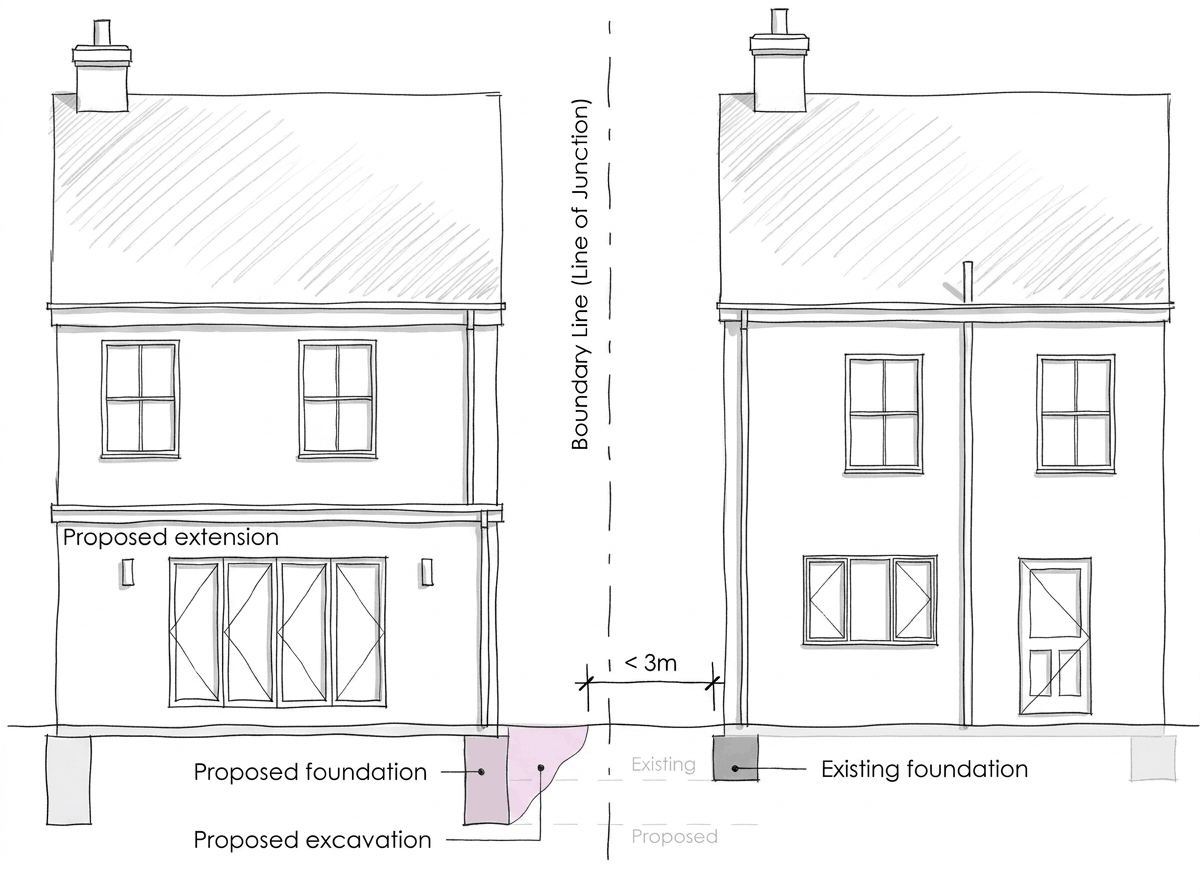
This is the first part of the section 6 check.
Will your excavation go deeper than the neighbour's foundations?
Most homeowners don't know their neighbour's foundation depth. Your builder, designer, structural engineer or party wall surveyor may need to help assess this. If you don't know, choose "I'm not sure".
A Section 6(1) notice is needed if you excavate within 3m and to a lower level than the neighbour's foundations.
Will your excavation or foundations within 6 metres pass below a 45-degree line from the neighbour's foundations?
This is not limited to piled foundations. It can apply to basement excavations, deep strip footings, mass-fill foundations or any other excavation that is deep enough — depending on the depth, distance, and the level of the neighbour's foundations. Your builder, designer or structural engineer may need to help check this.
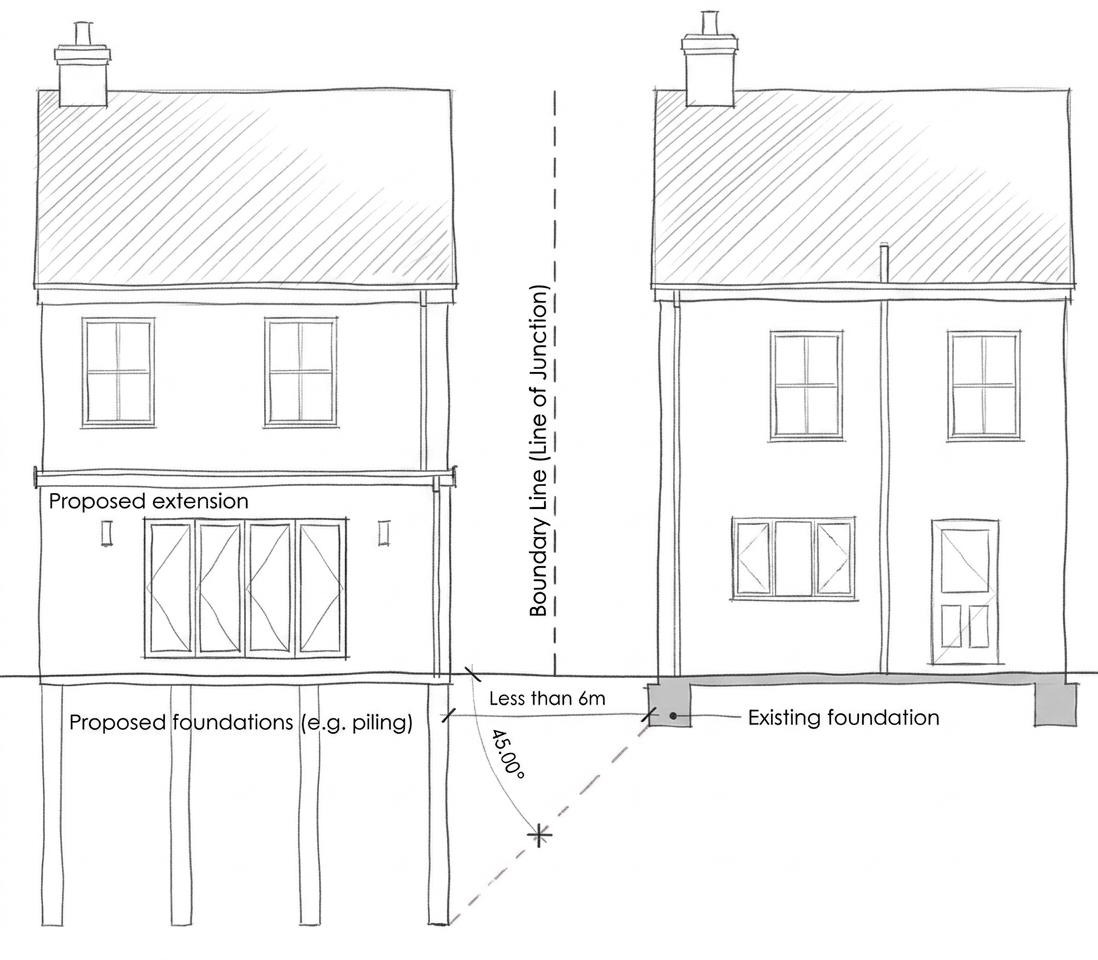
Section 6(2) applies where any part of the excavation, building or structure within 6m meets a 45° plane drawn from the bottom of the neighbour's foundations.
Are you building a new wall at or near the boundary with a neighbouring property?
This includes a new garden wall, a new flank wall to an extension, or any new wall built up to or across the boundary line. We'll ask exactly where the wall sits in the next step.
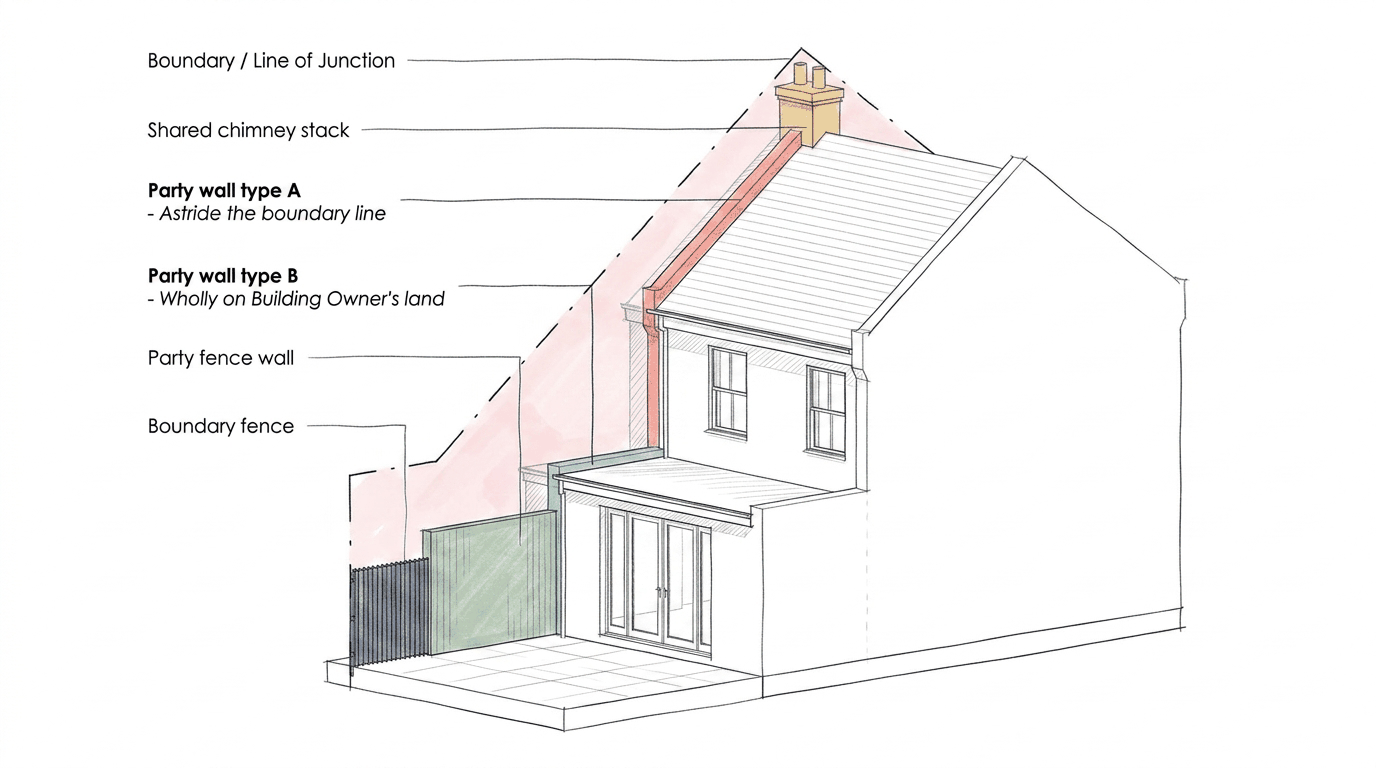
The line of junction is the boundary between your land and the neighbour's.
Where will the new wall be built?
The position of the wall matters. A wall wholly on your land is different from a wall built astride the boundary line.
Pick an option above to continue. You can change your answer.
Will any reinforced concrete or special foundation extend under the neighbour's land?
Special foundations can have different consent requirements. They usually mean reinforced concrete foundations (such as piles capped with reinforced beams, or a reinforced concrete raft) that project under the adjoining owner's land. If you're not sure, check with your designer, structural engineer or party wall surveyor.
If you don't have foundation details yet, choose "I'm not sure" — we'll flag this for review.
Will your work affect an existing shared wall, party wall, party fence wall, party structure, or separating structure?
This can include cutting into a shared wall for steel beams, removing a chimney breast, raising or thickening a party wall, repairing a party wall, cutting away projections, cutting flashing into a wall, or works to a structure separating flats.
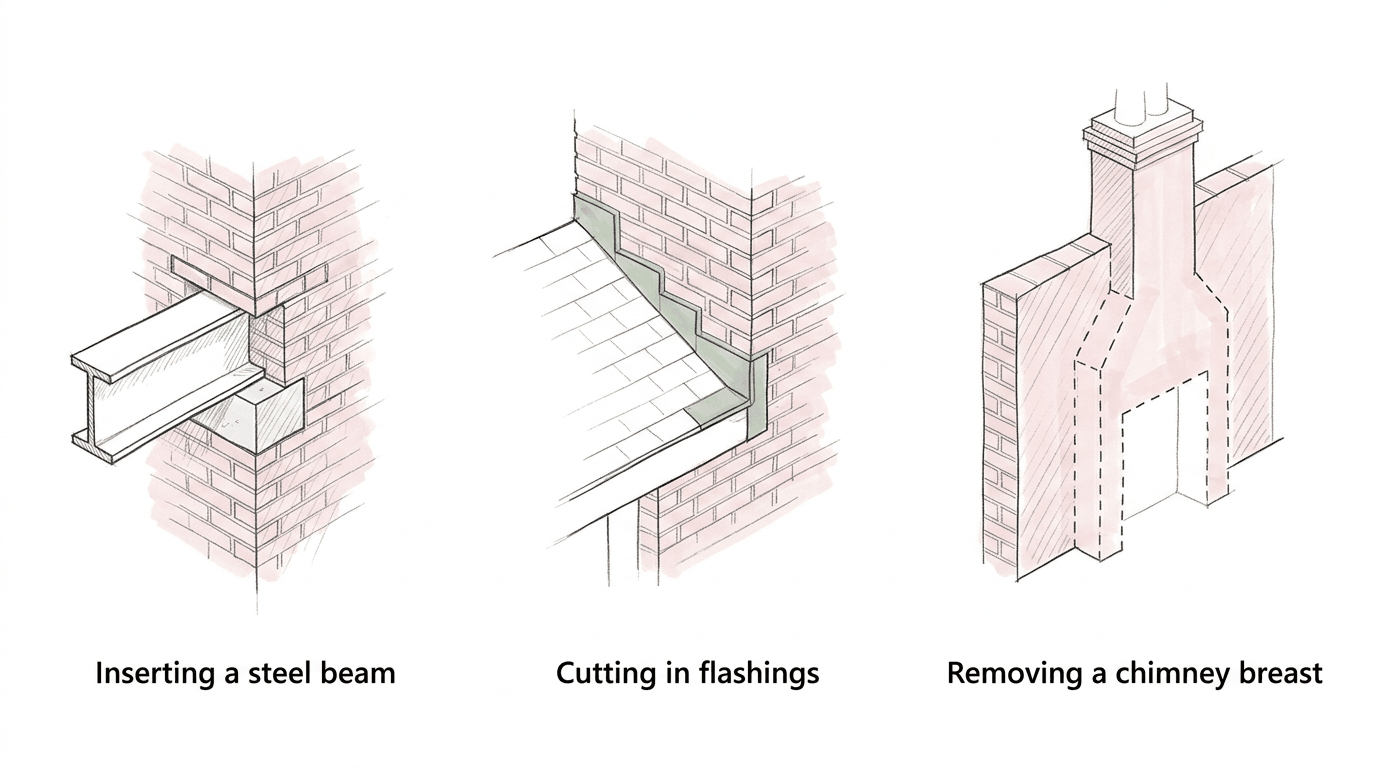
Includes raising, lowering, exposing, rebuilding or cutting away from the party wall.
Tick the works that apply.
Select every item that forms part of your scheme — multiple selections are normal. We use these to cite the correct sub-sections of section 2(2) on your notice.
If something close to your works isn't listed, pick the nearest match and you can refine the wording on the next screen.
No items selected yet.
Review your notice pack.
This is a draft summary based on the answers you have given. It is general guidance, not a legal opinion, and it does not confirm that any notice is valid or complete. Check each notice carefully before serving, and take advice from a suitably experienced party wall surveyor or legal adviser if anything is uncertain.
When you're ready, continue to generate the draft notices below — or go back to amend any answers.
No Party Wall notice identified from your answers.
Based on the answers you gave, we have not identified a Party Wall notice requirement. Before relying on this, check that:
- The work does not affect an existing shared wall or structure.
- You are not building a new wall at or near a boundary.
- You are not excavating near a neighbouring building or structure.
- No special foundations are proposed under adjoining land.
- Your answers are accurate.
If anything about your project changes, run the questions again.
Further checking needed.
Based on your answers, we have not confirmed that a notice is required, but some important information is uncertain. You should check the items below before relying on this result.
Items to check
If you can resolve the uncertainty, go back and update your answers — we'll re-check.
Who is carrying out the work?
Party Wall notices should name the building owner or owners. This usually means the legal owner of the property where the work is being carried out.
Please enter the address where the works will take place — or use "Continue as draft only" below.
Enter at least one building owner's full name — or use "Continue as draft only" below.
You can continue without all details — anything missing will be flagged on your final summary.
Who might be affected next door?
You may need to serve a separate notice on each affected adjoining owner. If you don't know a neighbour's name, you can use "The Owner" for now.
Enter at least one adjoining owner / property with an address — or use "Continue as draft only" below.
"The Owner" is a valid addressee under the Act if you don't know the name — but you should still make reasonable checks before serving.
Describe the proposed work.
A short plain-English description is fine — we'll handle the legal phrasing on the draft notice. We'll also ask a couple of follow-up questions based on the notices that may apply.
Please add a short description of the proposed works — or use "Continue as draft only" below.
Party Wall notices usually need to be served before works start. Party Structure Notices need 2 months; Line of Junction and Adjacent Excavation Notices need 1 month.
Missing technical detail won't block you, but it will be flagged on your summary.
Excavation drawings.
Because your answers suggest an Adjacent Excavation Notice may be needed, you should check whether suitable drawings are available before serving the notice. Excavation notices usually need plans and sections showing the proposed excavation and foundations.
- the site and the neighbouring building or structure;
- where the excavation will be;
- the proposed foundation depth;
- the distance to the neighbouring building or structure;
- enough information to understand whether the 3 metre or 6 metre rule applies.
The 6 metre rule is not limited to piled foundations - it can apply to other deep excavations too.
Do you have drawings or sections showing the excavation and foundation details?
- where the excavation is;
- how deep it is;
- how close it is to the neighbouring building or structure;
- the proposed foundation details;
- enough information to understand the 3 metre or 6 metre rule.
Pick an option above. You can change your answer.
Generate your draft notices.
You're about to generate draft notices for review based on the answers you entered. The drafts are not legal advice and we do not confirm that any notice is valid or complete. Do not serve a draft until you've checked everything below, and take advice from a suitably experienced party wall surveyor or legal adviser if anything is uncertain.
- Correct building owner name(s).
- Correct adjoining owner / addressee.
- Correct adjoining property address.
- Works description checked.
- Intended start date checked.
- Notice period checked.
- Drawings/sections attached where excavation notice applies.
- Separate notice served on each adjoining owner.
- Method of service recorded.
- Date of service recorded.
- Copies retained.
Each notice is paired with an acknowledgement page for the adjoining owner.
What might party wall surveying cost?
Three questions give an indicative range. We confirm a fixed fee in a formal proposal once we have seen the drawings.
From £875 + VAT
The building owner normally pays the adjoining owner’s surveyor’s reasonable fees.
Take the paperwork with you
- PDFParty wall notice templates
Section 1, 3 and 6 notices with guidance notes - WEBParty wall notices explained
Read the guide